

Defend the bombsite
You hold the angle. Attackers come from the three ways into B, either holding their own angle or running at you, and you choose the position, the cover and how much of you is exposed.
Sixty seconds to ten minutes of drills built on CS2's own numbers: m_yaw 0.022, a 73.74 degree FOV, the Source movement constants. At the end you get a readiness read and one sentence about what is off today.
The trainer is still being built, so it is open to Imba Premium Elite first: they play it early and tell us what is wrong before it ships. It costs nothing when it is finished.
See what Elite includes →What it actually is
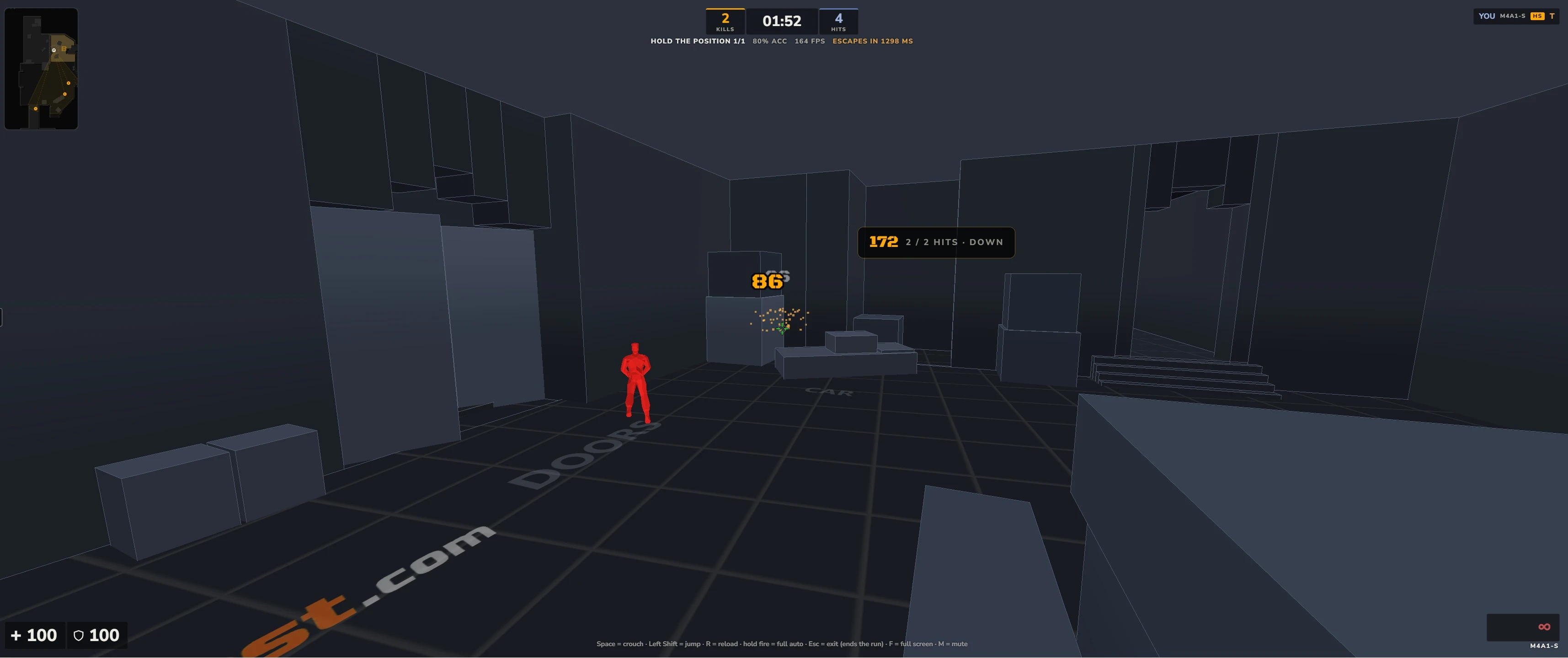
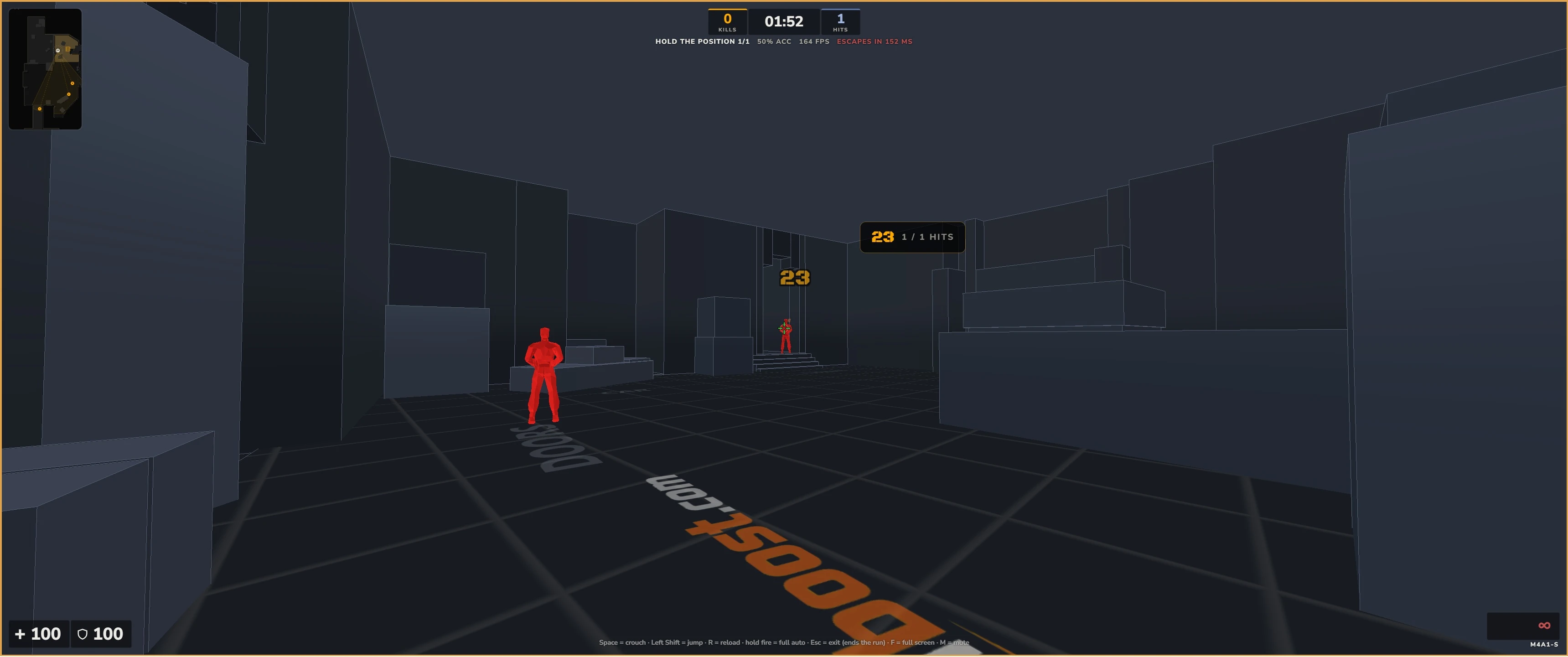
Every other browser aim trainer gives you dots on a grey background. This one puts you on bombsite B of Dust2, at the distances the map really has, against a model that takes damage where the game says it should.
You hold the angle. Attackers come from the three ways into B, either holding their own angle or running at you, and you choose the position, the cover and how much of you is exposed.
You are the one walking in. You pick the entry and how many defenders hold the site — and that is all you pick. Where they stand is drawn on the server, so nothing in your browser knows the answer before you do. They arrive in waves of one to three, never in the spot the last wave was cleared from, and the round ends on the last kill rather than on a timer.
Both sides run on the same four training modes: defend & attack a bombsite, sensitivity finder, spray path, counter-strafe.
Built on measurements
This is the part that separates a training tool from a game. If a figure is on this page, it came from the game or from professional play — and where we have not measured something, the page says so instead of inventing it.
Not from a table someone posted years ago. Two of the numbers that circulate online turned out to be wrong when we read the game itself, both on the M4A1-S — including one that claimed a headshot kill through a helmet that does not happen.
Measured against the game rather than estimated from a picture. The correction that mattered most was the head: the top of the skull counts now, the way it does in a real round.
AK-47, M4A4 and M4A1-S, bullet by bullet, in degrees — so the pattern holds at any resolution. Re-measured after CS2 updates, and the page that publishes them says when.
Checked at seventeen points around B; sixteen of them agree with the game to within 3.5 units. Distances, angles and what you can see from where are the map's, not an artist's impression.
The positions come from professional matches, not from our reading of the map — only spots that were actually held, in several separate rounds, made the list.
What the measurements produce is public. How they are taken is not — that part is the work.
How good are you, really
Not a speed slider somebody liked the feel of. Each level is how long a defender in a professional match actually takes between first seeing an attacker and firing at him.
Normal is the median professional. If he shoots first on that setting, you were slower than half the professionals in the same situation — which is a fact about you, not a difficulty curve.
A defender’s first bullet lands 33.5% of the time and takes 40 HP, on every level. We measured that once and have no measurement of how it changes with skill, so scaling it would be inventing a number. Every defender shoots as well as a professional does; the level changes only how long you have before he starts.
Source: six professional Dust2 demos across three events, 121 rounds, 116 clean reaction events and 155 opening bullets.
Advanced statistics
Every run ends on this screen. Each panel names what it counted and how many runs it rests on, and the ones that cannot answer yet say so instead of drawing a line through three points.
What you are doing wrong
A tip worked out from your run is worth ten general ones, so the page marks which is which. This library grows with every release.
Your first bullet leaves while the crosshair is still sliding from the last key you pressed.
Counter-strafe mode drills the stop itself: tap the opposite key, then shoot on the frame you are still.
Inside twenty metres your shots land on the chest, where two bullets are needed instead of one.
Set your crosshair at head height before you peek, not after the enemy appears.
Attackers who die most often clear one side, look back at it, and get shot from the side they left.
Clear an angle once, commit, and let the next angle be the next decision.
Closed beta
The trainer is free and it stays free. Imba Premium Elite play it while it is being built, and what they say changes what ships at 1.0 — that is the whole arrangement.
Every warm-up longer than a quick drill starts with a probe: 45 seconds of precision targets at a fixed size that never adapts. Then come the drills — precision and micro-flicks, reactive peeks, movement timing — and each one resizes its target to keep you in the useful band, roughly 80 to 92 percent accuracy, where you are neither coasting nor guessing. A drill that has settled ends early on its own. The 5- and 10-minute programs finish with a second probe, identical to the first, and the result is the difference between them: time per target, accuracy, path efficiency, consistency and reaction. Comparing the first minute of an adaptive session with its last would measure the adaptation, not you, which is why the probes exist.
After 5 saved warm-ups the trainer has a baseline for you, and from then on each warm-up ends with one of four words — cold, warming up, ready, sharp — based on how today's second probe compares with your own history rather than with anybody else's. There is no leaderboard and no rank here. The question this page answers is “am I warm”, and a ranking would turn it into “am I better than a stranger”, which is a different question with a different answer.
Your mouse is read as raw counts — every report it sends, not one sample per screen frame, so a 1000 Hz mouse on a 165 Hz display keeps all of its samples — and turned into angles with CS2's own m_yaw of 0.022 degrees per count, so your in-game sensitivity means the same thing here; the eDPI calculator works from the same number. Strafing follows the Source ground-move rules with the constants read from the CS2 console — sv_accelerate 5.5, sv_friction 5.2, sv_stopspeed 80, sv_maxspeed 320 — which is why counter-strafing stops you the way it does in the game, and why a shot fired while still moving misses here for the same reason it misses there. Your resolution and display mode, stretched or black bars, set the field of view and the aspect the targets are drawn at.
Accuracy, time to kill, reaction time from the moment a target appears, movement time and correction time split apart, path efficiency (how far your crosshair travelled against how far it needed to), first-shot discipline, overshoot, consistency, a left/right and up/down miss heatmap, and for movement drills the speed at the shot and the time from stopping to firing. The one-sentence diagnosis at the end picks the habit that costs the most rounds — it says so with a confidence level, and with fewer than six hits it says it does not know yet rather than inventing a weakness.
The Sensitivity Finder plays the same targets at five sensitivities in a shuffled order and names the one that scored best. Counter-Strafe measures stop-to-shot per side. Spray Path plays the recoil patterns we measured on our own CS2 install with the compensation path drawn in the scene, error per bullet and the tempo of your pull — whether the mouse reaches each bullet's point before or after the bullet leaves. Hold a position puts you on a measured defensive spot: silhouettes with their real angular size appear at the measured angles and stay only for the opening's exposure time, and one you do not hit in time escapes — the result says which angle keeps getting away. Signed in, every run also tells you where it sits among replayed runs on the same resolution and display mode, once that class has thirty of them.
Signed out, everything stays in this browser. Signed in, the trainer uploads the input log of each run — every mouse movement, shot and key press — and our server replays it through the same engine and stores its own numbers. The score you see was recomputed from what you actually did, not reported by the page. You can keep separate setups for a desktop and a laptop; each one has its own baseline, because a 60 Hz laptop and a 240 Hz desktop are not the same hands. Input logs are kept for 72 hours and then deleted; the scores stay.
It is not a rank booster, it does not touch your Steam account, and it does not promise anything about your next match. Aim is one input among many, and a warm-up is a warm-up. If you want the crosshair you train with to be the one you play with, the crosshair generator exports it as commands, and the autoexec generator keeps the rest of your config in one file.
Not affiliated with Valve Corporation. Steam and Counter-Strike are trademarks of their respective owners.